The House Looks Lovely. But Will The Neighbourhood Work? |
Before you commit to a new-build home, look at the streets, services and promises around it because a finished house does not always mean a finished community. |
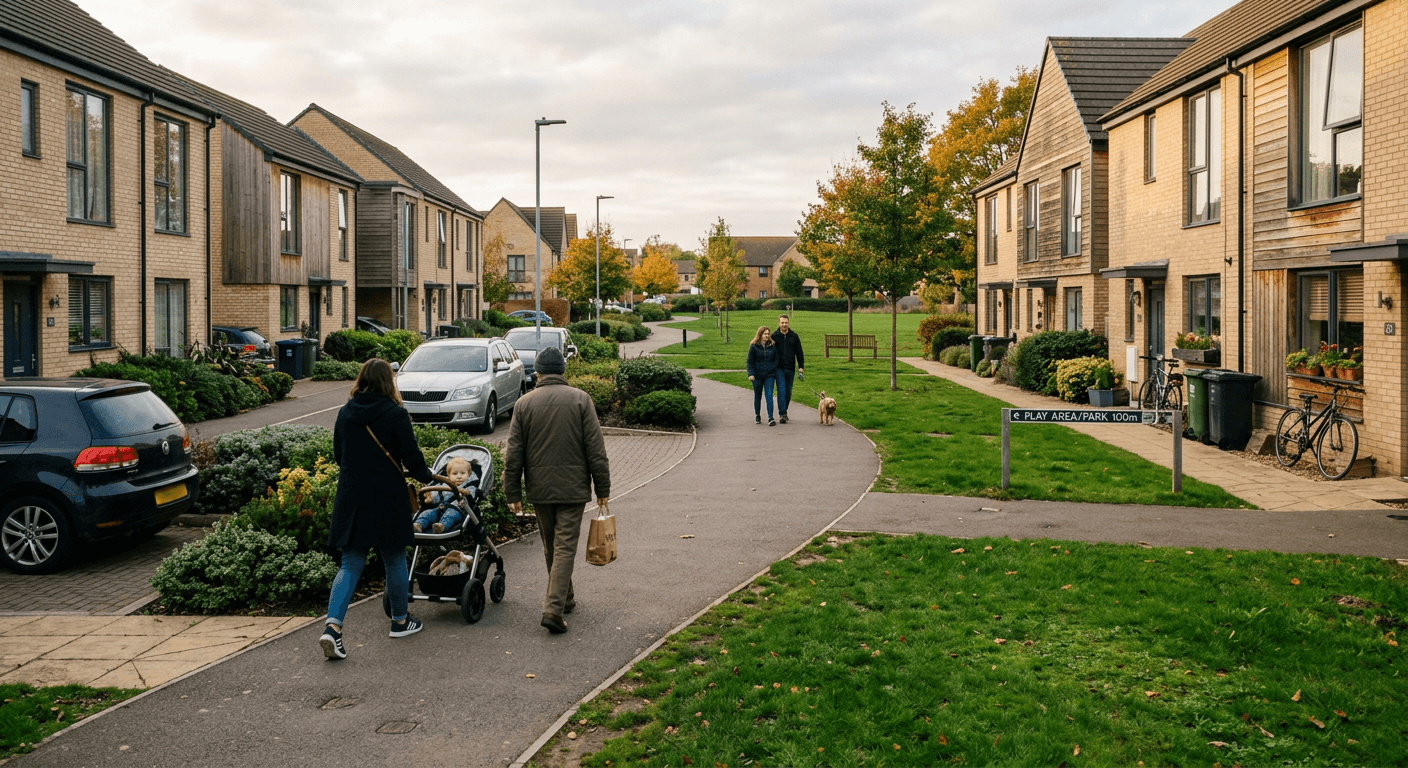
A show home can give you the warm, polished version of new-build life: clean walls, clever storage and not a wheelie bin in sight.
But the real test starts outside the front door.
Can you walk to a shop?
Is there somewhere for children to play that is more than a strip of grass?
Who looks after the open space?
What happens when the school run, the commute and a wet Tuesday arrive?
Those are the questions to ask before you decide that a development feels like home.
Cambridge has plenty of examples of new or expanding neighbourhoods where the plan reaches beyond individual houses.
At Clay Farm in Trumpington, the Clay Farm Centre brings together a community centre, library, café, medical centre and rooms for local activities at Hobson Square.
It is the sort of place that can give a neighbourhood a shared front room, rather than leaving every social need to a car journey into town.
The wider Cambridge East plans for Marleigh and Springstead Village also include more than housing.
The council’s progress map identifies local centres, schools, community buildings, allotments, sports grounds, public open space and walking and cycling connections.
Those features are not decorative extras.
They shape how often people leave the car at home, bump into neighbours and build routines.
But there is a catch. A facility shown on a plan is not the same as a facility you can use next month.
Some of the most attractive parts of a new development may arrive later, after the first residents have moved in.
A promised shop can still be an empty commercial unit.
A play area may be waiting for construction.
A bus route, community building or school can depend on later phases and separate decisions . So ask to see the delivery timetable, not just the artist’s impression.
Find out what is already open, what has planning permission, what is tied to a planning obligation and what is still a future ambition.
Cambridge City Council says Section 106 contributions from new housing are used for local infrastructure, including parks, play areas, community facilities and sports provision.
That gives buyers and renters a place to start: look at the planning obligations for the particular scheme and ask what they require, who is responsible and when the promised work is due.
The same check applies to the roads and green spaces.
Council records on unadopted residential developments describe concerns around unfinished roads, lighting, drainage, signs, play areas and open-space maintenance.
Responsibility can be split between a developer, a management company, Cambridge City Council, Cambridgeshire County Council and other bodies.
That can leave residents trying to work out who should fix the path outside their home or cut the grass beside the play area.
It is not the glamorous part of house-hunting, but it can become the bit you talk about most.
Ask the sales office for the estate-management arrangements.
Who owns the public spaces?
Who maintains them? Is there a service charge, and what does it cover?
Which roads and paths have been adopted, and which have not?
Get the answers in writing and compare them with the legal paperwork before exchanging contracts.
Then test the development on foot.
Walk from the homes to the nearest bus stop, school, shop, park and main road.
Do it at the time you would actually make the journey.
A route that looks short on a map may involve a muddy verge, a busy junction or a missing crossing.
Look for the small things that make daily life less sealed-off: benches, shade, safe crossings, cycle storage, places to sit, usable paths and rooms that local groups can hire.
Cambridge’s own list of investment at places including Akeman Street in Arbury, Campkin Road in King’s Hedges, Colville Road in Cherry Hinton, Ironworks and Timber Works in Romsey, L2 Orchard Park and East Barnwell shows how varied these ingredients can be.
A community centre is one answer. A park, café, nursery, allotment or sports space may be another.
There is a fair argument on the other side.
New developments do not need to imitate old villages overnight.
People can create community gradually, and not every useful place has to be inside the boundary.
A good bus link to an existing high street may be better than a small row of units that never fills.
But buyers should not have to guess.
The brochure should be the beginning of the conversation, not the final word.
Before your next viewing, save this short checklist:
• What can I use today, within a normal walk?
A new house can be excellent and the surrounding plan can still be unfinished.
The better viewing is the one that checks both.
Useful Resources
4. Improving accountability and transparency on unadopted residential developments motion, July 2026
5. Mitigating the impact of urban growth
|
0 Comments
Join the conversation
Be the first to comment
Share your thoughts above.