Main Article Headline |
Article Sub Headline |
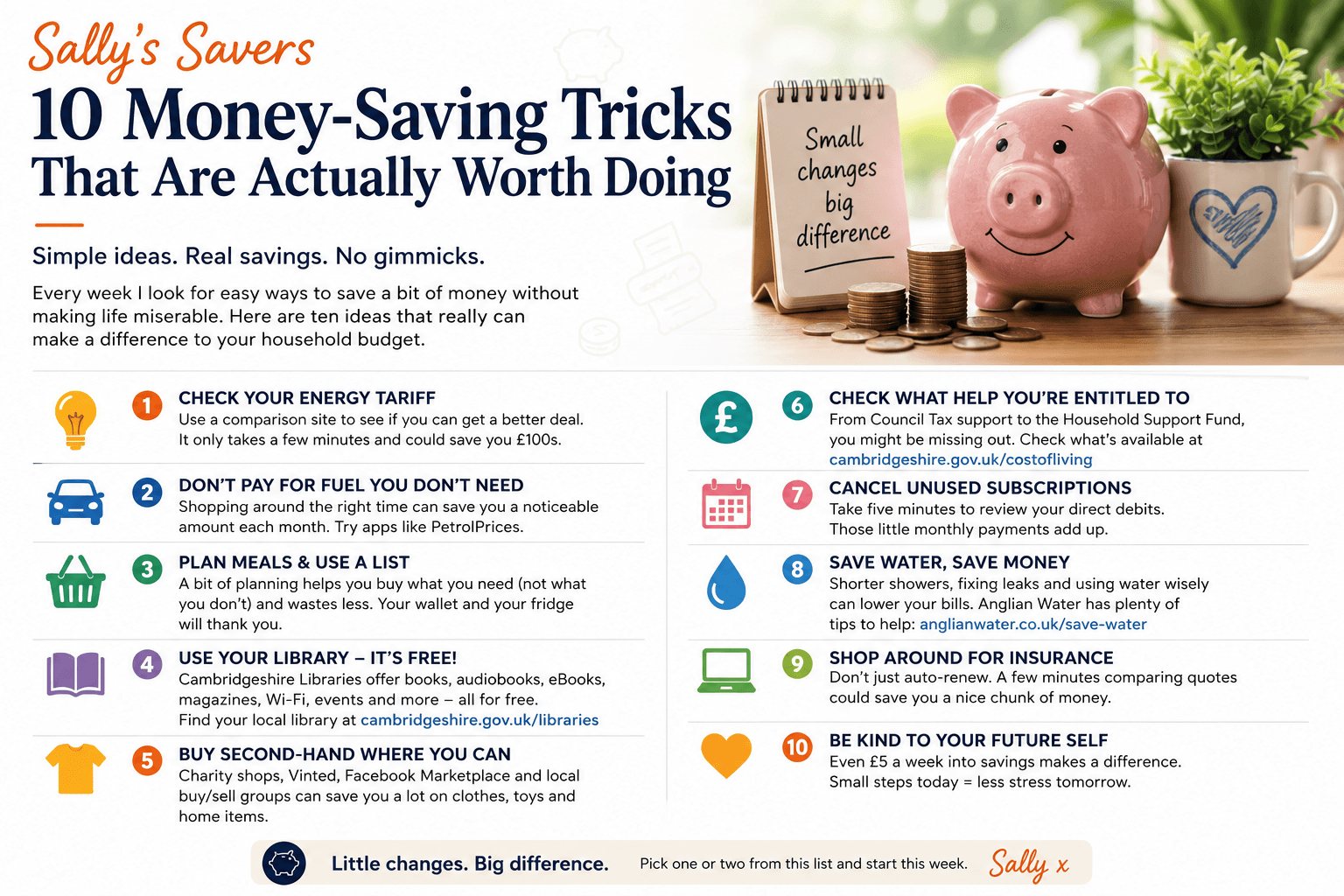
Sally’s Savers returns with ten practical ways to reduce everyday costs without making life miserable covering energy, fuel, food, libraries, second-hand buying, financial support, subscriptions, water, insurance and savings.
There are hundreds of ways to save 37p.
Spend three hours comparing loo rolls. Drive six miles because somebody has washing powder on offer.
Become the person who turns the heating off while everybody else is still in the house.
Sally's Savers is supposed to be more useful than that.
So we've picked ten things that are either quick to check, easy to change or potentially capable of saving considerably more than loose change.
You don't need to do all ten.
Find the two or three that make sense for you.
1. Check your energy tariff
Don't judge your energy deal purely by the amount leaving your bank account each month.
Look at the unit rates and standing charges you're actually paying and compare them with the alternatives available to you.
Also check the balance on your account.
If you've built up substantial credit, understand why it's there rather than simply assuming the energy company must need it.
A ten-minute check could be worth considerably more than ten minutes spent turning appliances off at the wall.
2. Don't pay more for fuel than you need to
Fuel prices can vary noticeably between filling stations, even within the same area.
If you're already passing several stations during your normal journeys, checking prices before filling up makes sense.
The important bit is already passing.
Driving halfway across Cambridgeshire to save 2p a litre rather defeats the exercise.
And don't automatically wait until the warning light appears. Knowing where the competitive local stations are gives you the choice of when to fill up.
3. Plan meals but start with the fridgeBefore writing next week's shopping list, open the fridge, freezer and cupboards.
What's already there?
Half a bag of potatoes, frozen chicken, pasta, three tins of tomatoes and enough rice to cater a wedding aren't things you need to buy again.
Plan a couple of meals around what you already own before planning what to purchase.
It's less about becoming an expert meal planner and more about not paying twice for food because the first lot disappeared into the back of a cupboard.
4. Use your library you've already paid for it
Cambridgeshire Libraries offer considerably more than shelves of books.
Depending on the service, membership can give access to eBooks, audiobooks, magazines, digital resources, computers, Wi-Fi, activities and events.
Before buying another book, audiobook or children's activity, see whether your library already provides something suitable.
And if you haven't had a library card for years, perhaps it's time to rediscover what comes with one.
Explore Cambridgeshire Libraries
5. Give second-hand five minutes before buying newThis isn't a campaign against new things.
It's a five-minute rule.
Before buying furniture, children's items, tools, bikes, clothes, garden equipment or something you'll use twice a year, check what's available second-hand.
Charity shops, local selling groups and resale platforms can be particularly good for things somebody else simply wants out of their house.
If there's nothing suitable, buy new.
But make “check first” the habit.
6. Check what help you're entitled to
This could potentially be the most valuable tip on the page.
People sometimes assume that because they're working, own their home or haven't claimed support previously, there can't be anything available to them.
That's not necessarily the case.
Depending on your circumstances, support can exist with council tax, childcare, household costs and other expenses.
Don't rule yourself out.
Use an official benefits calculator or local authority information and find out.
7. Go subscription hunting
Open your banking app.
Look through the last couple of months and find every repeating payment.
Then ask one question:
Would I sign up for this again today?
Streaming services. Apps. Software. Memberships. Cloud storage. Forgotten trials.
A single £8.99 subscription doesn't feel particularly dramatic.
Three forgotten £8.99 subscriptions cost more than £320 a year. Cancel the things you no longer value.
Keep the things you do.
8. Save water particularly if you're metered
If you have a water meter, using less water can mean spending less too.
The obvious changes don't require anybody to stop washing.
Shorter showers, fixing dripping taps, only running washing machines and dishwashers with full loads, and being sensible about garden watering can all reduce consumption.
It's also worth checking whether your water company offers free water-saving devices or advice.
Anglian Water money-saving advice
9. Never let insurance auto-renew unnoticed
Car insurance. Home insurance. Pet insurance. Breakdown cover.
Put the renewal dates in your calendar and add a reminder before they arrive.
That doesn't mean your current insurer is automatically expensive.
It means you should know what alternatives cost before agreeing to another year.
The expensive habit is often not staying.
It's not checking.
10. Be kind to your future self
Saving money isn't only about cutting bills.
If your finances allow it, even a modest regular amount moved automatically into savings can start creating a buffer for the things life inevitably throws at you.
£5 a week is £260 over a year.
£10 is £520.
The amount doesn't need to impress anybody.
The important part is building the habit.
And if money is currently too tight to save anything?
Skip this one without guilt and concentrate on the other nine.
Sally's Saver This Week
Don't attempt a complete financial makeover on Sunday afternoon. Pick one bill, one recurring payment and one spending habit.
Check those three.
If one saves you money, you've achieved more than you would by reading another 50 money-saving tips and doing none of them. |
0 Comments
Join the conversation
Be the first to comment
Share your thoughts above.