
Taking An Electric Car On A Long Trip? The Cambridgeshire Checks That Stop Charging Becoming A Gamble |
A big journey is less about chasing a perfect range figure and more about having the right route, payment options and a backup plan. |
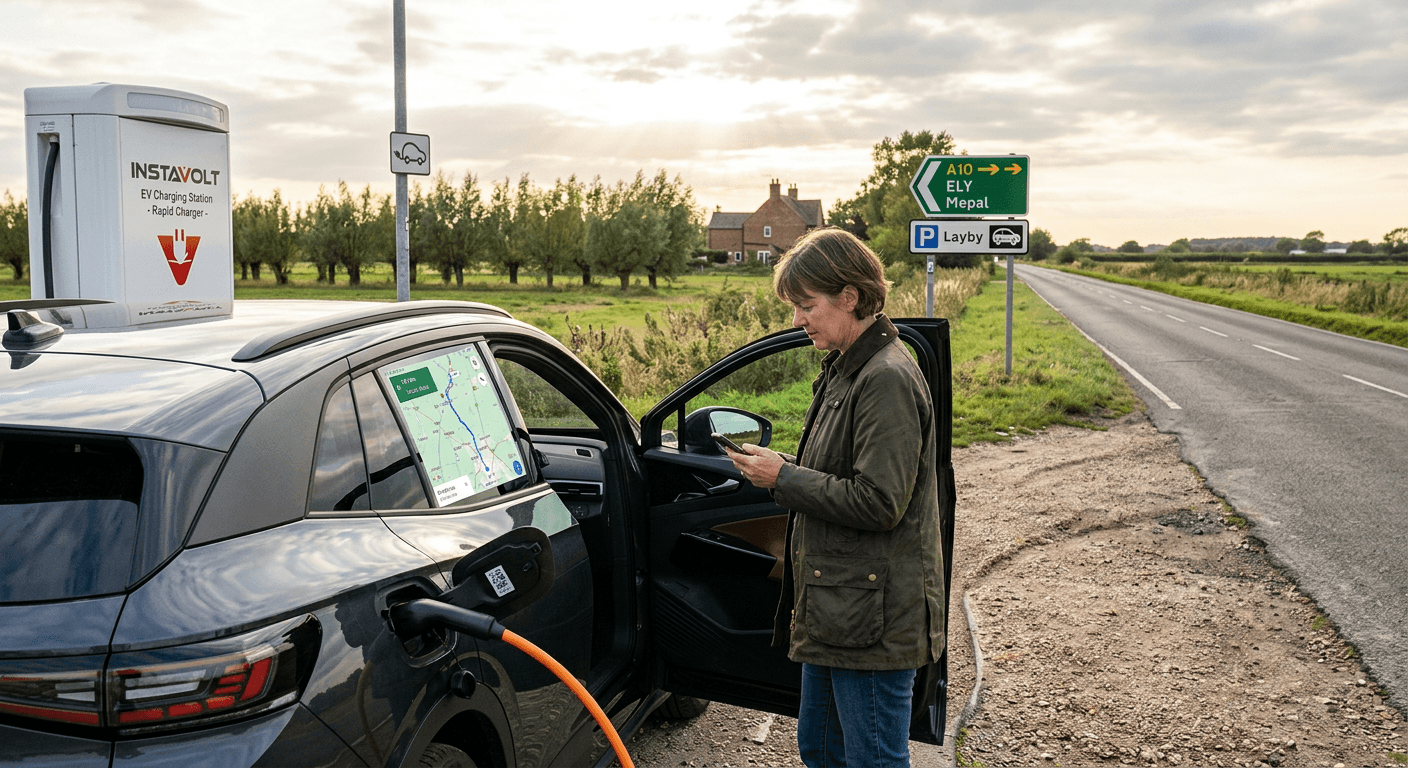
Yes, you can take an electric car from Cambridgeshire on a long European trip without getting stranded.
But the relaxed version of the journey starts before you leave the driveway.
The mistake is treating the car’s range display as a promise.
It’s an estimate, and it can fall faster than expected in cold weather, heavy traffic, strong winds or at motorway speeds.
A 1,500-mile European road trip published by Which? reached the same fairly unglamorous conclusion: watch how quickly the remaining range is dropping and change your charging plan instead of blindly trusting the number on the dashboard.
That sounds less exciting than plugging in and setting off. It’s also how you avoid the sweaty final miles.
Start with the route, not the charger
Put your destination into a route planner that knows your car model.
Zapmap lets drivers filter by vehicle, connector, charging speed, payment method and access rules.
It also shows live-status information, which is far more helpful than finding a charger that looked fine when somebody added it to a map months ago.
For a Cambridgeshire departure, think about the first proper charging opportunity before you think about the most ambitious distance your battery can cover.
The A14 and M11 are obvious escape routes towards the Midlands, London and beyond, and the A14 Cambridge-to-Huntingdon stretch carries plenty of commuter and long-distance traffic.
Check the road before leaving, not just the battery.
A crash or overnight closure can turn a neat charging plan into a very long detour.
Give yourself a reserve.
Arriving with one or two per cent left might look efficient on paper, but it leaves no room for a full charger, a diversion or a queue.
A more comfortable plan reaches the stop with enough charge to continue to another option if the first one is occupied or out of order.
Your local fallback is part of the plan
It’s worth knowing where you could charge close to home if the car needs a top-up before departure, or if your home charger lets you down.
Cambridge City Council lists charging points in car parks including Park Street, Queen Anne Terrace, Castle Hill, Gwydir Street, Adam and Eve Street, Campkin Road and Norfolk Street.
The Babraham Road and Trumpington Park & Ride sites are also listed among the council’s charging locations.
Most of the council points are operated by Connected Kerb.
Cambridge City Council says drivers should check prices through the operator’s app or website, and reminds users that normal car-park charges still apply.
Some charging bays also have a four-hour daytime maximum stay. So a charger being available does not automatically mean you can leave the car there all day while you explore the city.
That is exactly the sort of small local detail that can derail a supposedly simple plan.
Check the location, opening or access rules, parking charges and time limits before relying on it.
Make the charging stop boring
The least stressful charging stop is one with a job attached to it.
Pick a service area, café, supermarket or rest stop where you were going to pause anyway.
Charging then becomes part of the journey rather than a separate emergency mission.
Before setting off, check three things for each planned stop:
- Is the connector compatible with your car?
Do not assume every charger uses the same app, and do not assume the charger you want will be free when you arrive.
If the network offers contactless payment or roaming, know how that works before you are parked beside the machine with a queue behind you.
Save the operator’s helpline details as well.
It also helps to plan a second charger near every major stop.
Not a theoretical one 40 miles away, but a real alternative that your car can reach if the first site is full or faulty.
Check it again shortly before you need it, because live availability and prices can change.
Don’t charge to 100 per cent just because you can
Long trips can encourage drivers to wait for a completely full battery at every stop.
That may leave you sitting longer than necessary.
Often, adding enough energy to reach the next sensible stop with a reserve is the calmer choice.
The right stopping pattern depends on the car, the weather, the road and how quickly the charger works.
Watch the car’s consumption during the first part of the journey.
If the range is falling more quickly than expected, stop earlier and revise the next leg.
The plan is there to help you, not to win an argument with the sat-nav.
Finally, check the destination. A hotel, holiday cottage or campsite may advertise parking without offering a charger, and a destination charger may have access rules or need advance booking.
Confirm what is actually available before you arrive.
So the answer is not “never take an EV far from home”.
It is “don’t make one charger and one range estimate responsible for the whole trip”.
Start with a route built around your car, leave a reserve, keep a backup stop and check the details again on the day.
If you’ve found a particularly reliable charging stop on the A14, M11 or elsewhere in the county, send us the location and what made it work.
Specific tips are far more helpful than another argument about whether electric cars are ready for long journeys.
USEFUL RESOURCES
|
0 Comments
Join the conversation
Be the first to comment
Share your thoughts above.