
£400m And 1,000 Scientists: Cambridge Just Landed Another Huge Investment |
GSK is investing £400m in a new Cambridge R&D centre. We examine what 1,000 more scientists could mean for jobs, housing, transport and local businesses. |
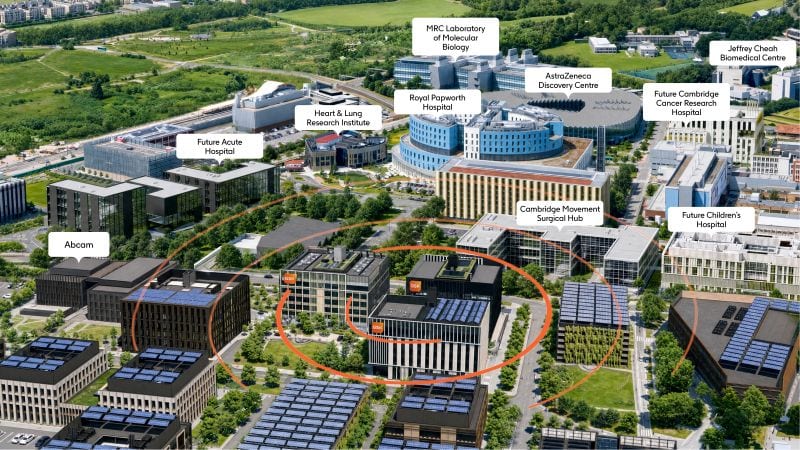
GSK is moving its main UK research hub to Cambridge. That's a major vote of confidence but what happens when another 1,000 highly skilled workers join an already pressured part of the county?
Pharmaceutical giant GSK has announced a £400 million investment that will include a new flagship research and development centre at the Cambridge Biomedical Campus.
And this isn't a small satellite office.
More than 1,000 scientists currently based at GSK's Stevenage research facility are expected to move to Cambridge, with the new 300,000 sq ft centre planned as part of a phased relocation by 2029.
That's enormous news for Cambridge.
It reinforces something the city has been building for decades: a concentration of science, medicine, technology and research that attracts investment most UK cities would love to have.
The Biomedical Campus already brings together major hospitals, research institutions and life-sciences businesses.
Now another international pharmaceutical heavyweight is putting hundreds of millions behind being there.
But here's the Cambridgeshire bit
A thousand scientists don't simply arrive at a laboratory every morning and disappear again at 5pm.
They need homes.
Trains.
Roads.
Schools.
Restaurants.
Shops.
Childcare.
Tradespeople.
Cleaners.
Gyms.
Coffee.
And somewhere to park, cycle or catch a bus.
Some will live in Cambridge.
Plenty won't.
That potentially pushes the economic effect out towards places such as Sawston, Great Shelford, Cambourne, Ely, Newmarket, St Neots and surrounding villages.
And that's where a £400m Cambridge announcement becomes a much bigger local story.
The opportunity
Big employers create ecosystems around them.
More highly paid workers can mean more customers for independent businesses, increased demand for professional services, stronger housing demand and opportunities for companies supplying the campus itself.
A restaurant doesn't need a pharmaceutical contract to benefit from 1,000 more people working nearby.
Neither does an estate agent, dog walker, nursery, electrician or coffee shop.
The pressure
There is another side.
Cambridge isn't exactly struggling to make houses expensive. Transport into the city is already contentious.
Infrastructure is already trying to catch up with growth.
And the new Cambridge South station which we covered last week suddenly looks even more significant when major employers continue concentrating around the Biomedical Campus.
So perhaps the interesting number isn't £400 million.
It's 1,000 people.
Because investment ultimately lands somewhere.
In houses. On trains. On roads. Inside businesses.
And in communities considerably further away than the Cambridge city boundary.
That's why this isn't merely a Cambridge business story.
It's a Cambridgeshire one.
|
0 Comments
Join the conversation
Be the first to comment
Share your thoughts above.