Main Article Headline |
Article Sub Headline |
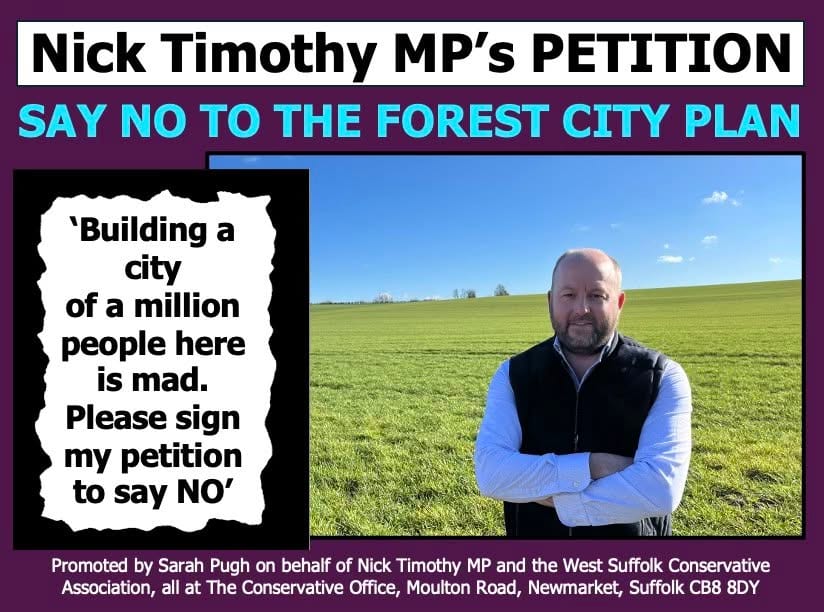
A development called a “Forest City” is already being pulled into a political fight around the Cambridgeshire-Suffolk border between Newmarket & Haverhill Tory MP Nick Timothy has called for the idea to be stopped, while the businessmen behind it Shiv Malik and Joseph Reeve have said it is still going ahead.
That leaves local people with a rather awkward starting point: the argument is moving faster than the detail.
The name sounds grand. It also sounds green. But “Forest City” is a label, not yet an answer to the questions residents will reasonably ask about homes, roads, water, farmland, jobs, wildlife and who would pay for it all.
So what is actually being proposed?
The confirmed picture from the available reporting is limited. It is a reported development idea somewhere on, or close to, the Cambridgeshire-Suffolk border on upto 45,000 acres of farmland.
The public case for it has been described as a forest-led scheme, and its backer has said the plan remains alive.
The criticism from an MP is that it would be dangerous and should be abandoned.
That is enough to explain why people are talking. It is not enough to decide if the idea is sensible.
The first test is a map.
Not a broad description of the border.
Residents need to see the exact area, the boundary of the proposal and the settlements, farms, roads, waterways and habitats within it.
Until that is clear, people cannot judge who would be affected or even know which council documents to look for.
The second test is status.
Is this a concept being promoted by a private backer, a formal planning proposal, a council-backed growth project or something else?
It has come to light that Matthew Pennycock the government Housing & Planning Minister also has stated the government won't back the proposal as it fails a number of key objectives.
Those routes are very different and lack of the government support may mean things are about to get even bumpier for the proposal.
A publicity campaign does not give a project planning permission.
A planning application would bring a defined site, technical reports and a formal route for public comments.
A policy proposal would need to fit into the relevant local plans and growth strategies.
The decision-makers may not be in one place, either.
A scheme on the county boundary could involve more than one local authority, alongside national bodies responsible for roads, water, the environment or other infrastructure.
Residents of the areas involved should not have to piece that together from a slogan.
Then there is the word “forest”. Planting trees can bring real benefits.
More woodland could improve wildlife habitats, provide shade and create public space.
A large development might also bring new homes, employment and investment if the numbers stack up and the infrastructure arrives first.
But a tree-filled brochure is not an environmental assessment.
The proposal would need to show what would be planted, where, when and how it would be maintained.
It should explain the effect on existing habitats, farmland, drainage and water use.
It should also be clear if “forest” means public woodland, private landscaping around housing, commercial forestry or a mixture of all three.
The same scrutiny applies to the city part.
How many homes are being discussed? What type? Where would schools, doctors’ surgeries, shops and community facilities go? How would people travel to Cambridge, Newmarket, Bury St Edmunds or nearby villages? Would new roads make existing congestion worse before promised alternatives appear?
Those are not anti-development questions.
They are the questions that separate a real long-term place from a striking name and a set of artist’s impressions.
The MP’s objection deserves attention, but it is not proof on its own that the proposal would cause harm.
Politics can sharpen a debate before the technical work is complete.
The counterargument also deserves testing: a forest-led settlement could offer environmental and economic gains, but only if its funding, land management, transport plans and public benefits are written down and enforceable.
For now, the sensible position is neither automatic support nor instant dismissal.
Cambridgeshire residents need the red-line map, the developer’s full objectives, the evidence behind the environmental claims and a clear explanation of the planning route.
They also need to know when and where consultation will happen, and who will be responsible for answering objections.
If the idea reaches a formal stage, the paperwork will tell us far more than the name.
Until then, “Forest City” should be treated as a proposal to examine, not a finished place and not a proven threat.
What would you want to see first: the exact location, the transport plan, the environmental evidence, or the funding and maintenance arrangements?
Tell us the one document or answer that would shape your view, and we can use the responses to decide what to follow next. |
0 Comments
Join the conversation
Be the first to comment
Share your thoughts above.