Article Sub Headline |
A secret Cold War bunker, an extraordinary Fenland cathedral, Cromwell's old home and a village connected to one of Britain's most notorious historical mysteries.
Cambridgeshire gets considerably stranger when you look beyond the obvious.
Living somewhere is a remarkably effective way of stopping yourself from exploring it.
You pass the sign.
Say, “We should go there sometime.”
Then drive past it for another twelve years.
So we've gone looking for seven Cambridgeshire places where the story is considerably more interesting than the everyday surroundings suggest.
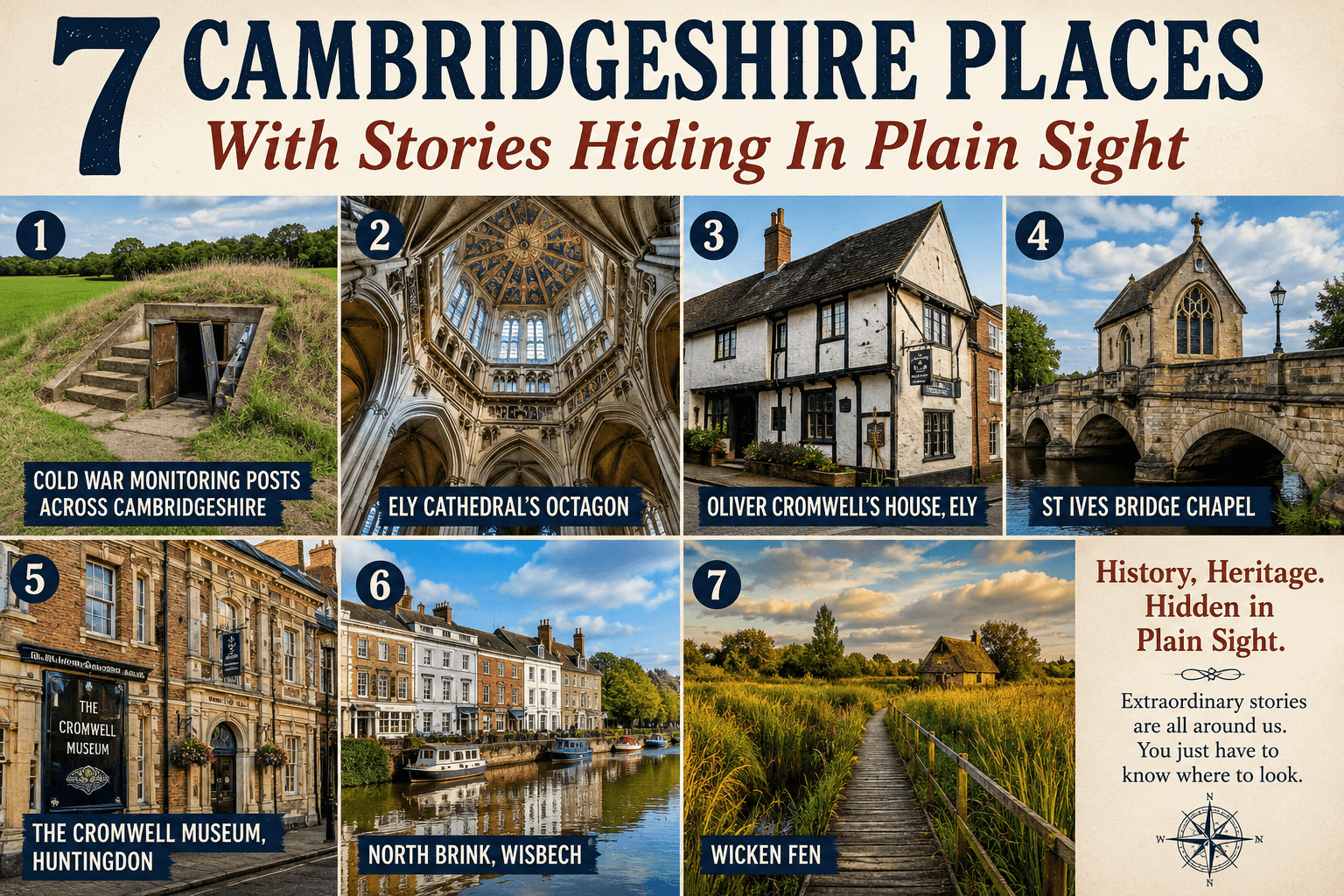
1. Cold War nuclear monitoring posts were hidden across Cambridgeshire
For decades, some very ordinary-looking patches of Cambridgeshire countryside concealed a much darker purpose.
During the Cold War, the Royal Observer Corps operated underground monitoring posts around Britain, including sites across Cambridgeshire.
They weren't bunkers designed to shelter the general public.
Small teams of observers would have used them to monitor nuclear explosions and radioactive fallout if Britain had been attacked.
The posts were typically underground rooms reached through a small surface hatch which meant you could pass remarkably close to one without having any idea what was beneath you.
Examples have been recorded around the county, including sites near Fulbourn, Gamlingay, Linton and elsewhere across the old Cambridgeshire network.
Most were eventually closed as the Cold War ended, but traces of this extraordinary nationwide warning system still survive. It's a strange thought:
The Cambridgeshire countryside we now associate with dog walks, fields and villages once contained people preparing to measure the fallout from a nuclear war.
2. Ely Cathedral has been dominating the Fens for roughly 900 years
Ely's landscape makes its cathedral particularly extraordinary.
For centuries, travellers crossing the flat Fenland landscape could see the enormous building from miles away hence its famous nickname:
The Ship of the Fens.
But look upwards once you're inside.
The cathedral's remarkable Octagon was created after the original central tower collapsed in 1322.
Rather than simply rebuilding what had fallen, medieval builders created the vast octagonal structure and lantern that now makes Ely Cathedral so distinctive.
Nearly 700 years later, we're still looking at their solution to a catastrophic building failure.
3. Oliver Cromwell's old house is still standing in Ely
Before becoming one of the most controversial figures in British history, Oliver Cromwell lived in Ely with his family for around a decade.
The house associated with him survives near the Cathedral and is now a visitor attraction.
Whatever your opinion of Cromwell military leader, republican hero, dictator, villain, or some uncomfortable mixture of all four it is peculiar to think of someone who would eventually help overthrow a king simply going about everyday family life in Ely.
History wasn't history yet.
It was just somebody living down the road.
4. St Ives has a chapel sitting in the middle of its bridge
Cross the old bridge at St Ives and you'll find something extremely unusual.
There's a medieval chapel built into the bridge itself.
Bridge chapels once existed in various places around England, but very few survive.
The St Ives example dates from the 15th century and is one of only a handful remaining.
The bridge has subsequently survived alterations, wars, traffic and centuries of people crossing the Great Ouse.
Next time you're there, don't just look at the river.
Look at the little building sitting on the bridge.
5. Huntingdon gave Britain Oliver Cromwell too
Ely gets Cromwell's house.
Huntingdon gets his beginning.
Cromwell was born in Huntingdon in 1599, and the town's Cromwell Museum occupies the former grammar school where he was educated.
And he wasn't the only famous pupil.
Samuel Pepys whose diary became one of our greatest eyewitness accounts of 17th-century England also attended the school.
So one relatively modest Huntingdon building connects two people whose accounts and actions helped shape how we understand an entire period of British history.
Not bad for an old schoolroom.
6. Wisbech has one of the country's great Georgian streetsWisbech doesn't always get treated like a heritage destination.
Walk along North Brink and that starts looking rather unfair.
The Georgian architecture beside the River Nene gives this part of Wisbech a completely different character, with Peckover House among its best-known buildings.
But the bigger story is why grand houses appeared here in the first place.
Wisbech developed as an important Fenland port and trading centre.
The elegant buildings weren't randomly dropped into town.
They are evidence of a period when trade and the river brought considerable prosperity to this part of the Fens.
Sometimes architecture is just an old bank statement made of bricks.
7. Wicken Fen helped create the National Trust we know todayWicken Fen looks ancient.
Its conservation story is surprisingly modern.
In 1899, the National Trust acquired its first small piece of land at Wicken Fen.
Over the following century, the reserve expanded enormously.
Today it protects one of Britain's oldest nature reserves and a surviving fragment of the Fenland landscape that once covered a vastly greater area.
That makes Wicken more than somewhere for a Sunday walk.
It's part of the early history of the National Trust's conservation work.
And it's a reminder of how dramatically Cambridgeshire itself has changed. The best bit?
None of these requires us to invent a new attraction. They're already here.
Fulbourn. Ely. St Ives. Huntingdon. Wisbech. Wicken...
And that's only six parts of a very large county.
Cambridgeshire is full of places that become considerably more interesting once somebody tells you what you're actually looking at.
Perhaps that's the real challenge:
Stop driving past them. |
0 Comments
Join the conversation
Be the first to comment
Share your thoughts above.